

ENVIRONMENT
The Etam Group is continuing the transformation of its business model to reduce its environmental footprint. A signatory of the Fashion Pact in 2020 and B Corp™ certified in 2025, the Group embeds its environmental commitments within recognized and robust frameworks.

CARBON REDUCTION TARGETS ALIGNED WITH THE PARIS AGREEMENT
Fully aware of its role within a rapidly evolving textile industry, the Group has been taking action since 2021 to reduce greenhouse gas emissions generated by all of its activities, both direct and indirect.
By 2030, the Group is committed to reducing its Scope 1 and 2 emissions by 80%. For its Scope 3 emissions, the Group aims to achieve a 40% reduction in GHG emissions per product over the same period.
These targets are aligned with a 1.5°C trajectory, consistent with limiting global warming to 1.5°C by 2100. The Science Based Targets initiative (SBTi) has validated these reduction targets as compliant with the Paris Agreement.
In 2025, the Group’s total emissions amounted to 368,231 tonnes of CO₂ equivalent, representing a 36% decrease compared with the 2019 baseline year. Scope 1 and 2 emissions amounted to 2,335 tonnes of CO₂ equivalent, representing a 73.7% reduction compared with 2019.
With regard to Scope 3, emissions intensity decreased form 7.60 kg CO₂ per product in 2019 to 6.42 kg CO₂ per product in 2025, corresponding to a 15.5% reduction.
ENERGY
The Group has implemented an energy efficiency plan to reduce overall energy consumption. This plan includes a range of initiatives such as LED lighting upgrades, lighting management systems, employee awareness programmes, and automated systems to optimise heating and air conditioning. In 2025 these measures resulted in a 23% reduction in energy consumption compared with 2019.
Today, 100% of electricity consumed across the Group’s head office, stores, and warehouses in France, Belgium, Spain, and Poland comes from renewable sources, supported by Guarantees of Origin.
FREIGHT TRANSPORT
For the transportation of goods, the Group prioritise sea and rail freight, which generates lower greenhouse gas emissions. In 2025, 94% of goods were transported by sea.
In addition, to reduce transport distances, the Group has implemented direct shipping flows from Asian factories to Mexico and Thailand, avoiding routing via European logistics platforms.
The Etam is committed to monitoring and reducing the environmental impact of its products. Since 2019, this commitment has been implemented through WeCare, the Group’s programme dedicated to more responsible product design. The WeCare standard, which sets the framework for the programme, defines clear criteria for responsible products: containing at least 50% more sustainable fibres, or incorporating an innovation that significantly reduces environmental impact.
In 2025, 61.22% of products met these criteria, compared with 2.97% in 2019. This acceleration demonstrates both strong internal mobilisation and the Group’s determination to drive meaningful change. In 2025, these products represented 34 million items across all Group brands: Etam, Undiz, Maison 123, and Ysé.
OUR ORGANIC COTTON PRODUCTS
The Group is pursuing a clear ambition regarding cotton: to replace conventional cotton with certified organic cotton. This transition is already well underway, with three out of four cotton products sourced from certified organic supply chains in 2024.
Since 2023, the Group has been certified to the Global Organic Textile Standard (GOTS), a leading international standard that guarantees the use of cotton fibres from organic farming. GOTS certified products contain at least 70% of certified organic fibres and meet rigorous environmental and social criteria, including respect for human rights across the value chain. In 2025, 75% of cotton products were certified organic.
Certified by EGL / 280073 / 280076 / 280077 / 280080
OUR RECYCLED SYNTHETIC FIBRES
The Group is also committed to progressively replacing virgin synthetic fibres with recycled alternatives, certified under GRS (Global Recycled Standard) or RCS (Recycled Claim Standard).
These materials help preserve non-renewable resources and contribute to waste reduction, fully aligned with a circular economy approach.
Today, one in two products containing synthetic fibres is made from GRS or RCS certified recycled materials, illustrating tangible progress in this transition.
WECARE LABEL
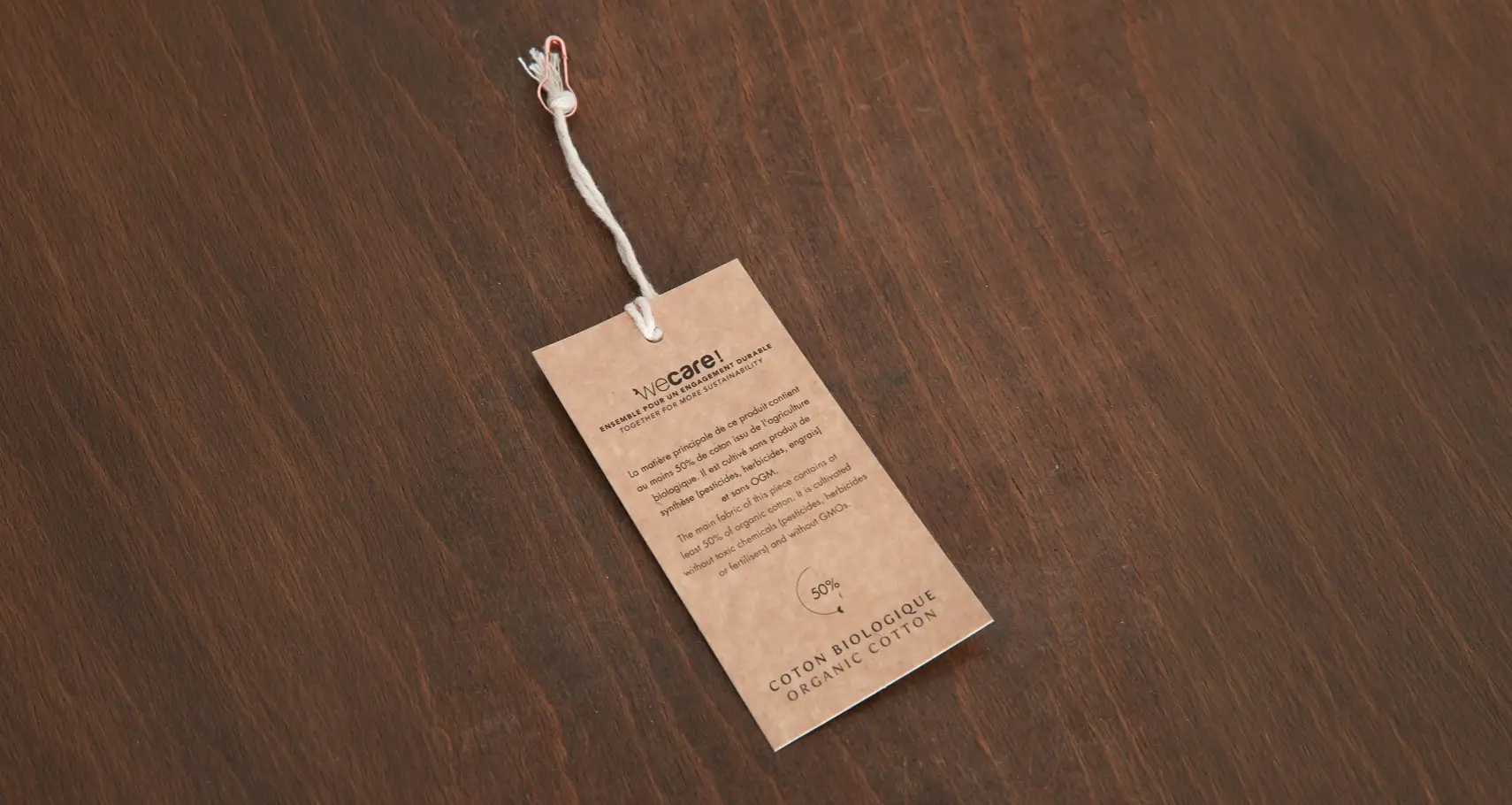
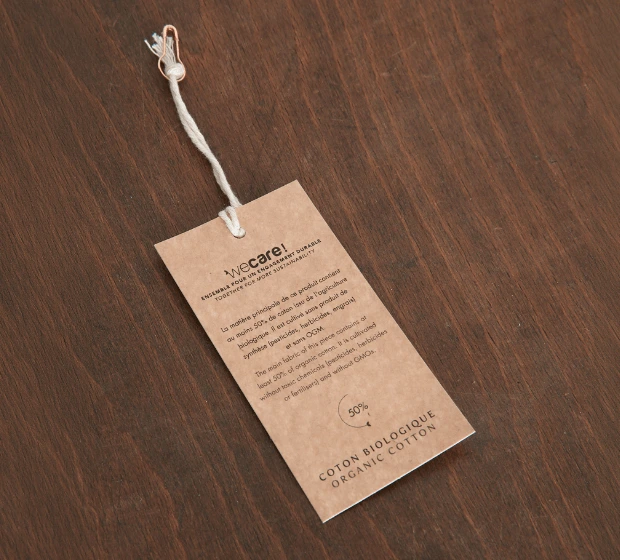
The label provides all the information on product composition, including: the presence of more responsible materials, details of the processed used, and associated environmental benefits, such as reduced energy consumption.
The Group has developed several circular initiatives to extend product lifecycles and improve end-of-life management. Since 2028, 67 tonnes of clothing have been recovered and repurposed through these programmes.
ETAM – PETIT GESTE, JOLI SOUTIEN
Since 2021, Etam’s programme “Petit Geste, Joli Soutien” enables customers to drop off used bras in over 500 European stores. After sorting and cleaning by a social entreprise supporting workforce integration, bras in good condition are donated to women in vulnerable situations. More than 400,000 bras have been collected since launch.
MAISON 123 – SECONDE VIE
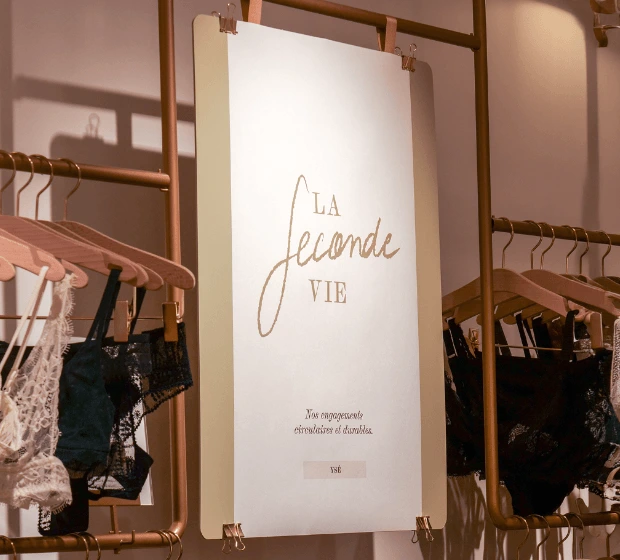
Since 2024, Maison 123 has been rolling out its second-hand programme through its “Seconde Vie” platform, inviting customers to resell and purchase pre-owned pieces from the brand, giving them a new lease of life. Each garment is carefully inspected once received, repaired where necessary, and thoroughly cleaned to restore it to its original condition.
MAISON 123 – SECONDE VIE, Acte II
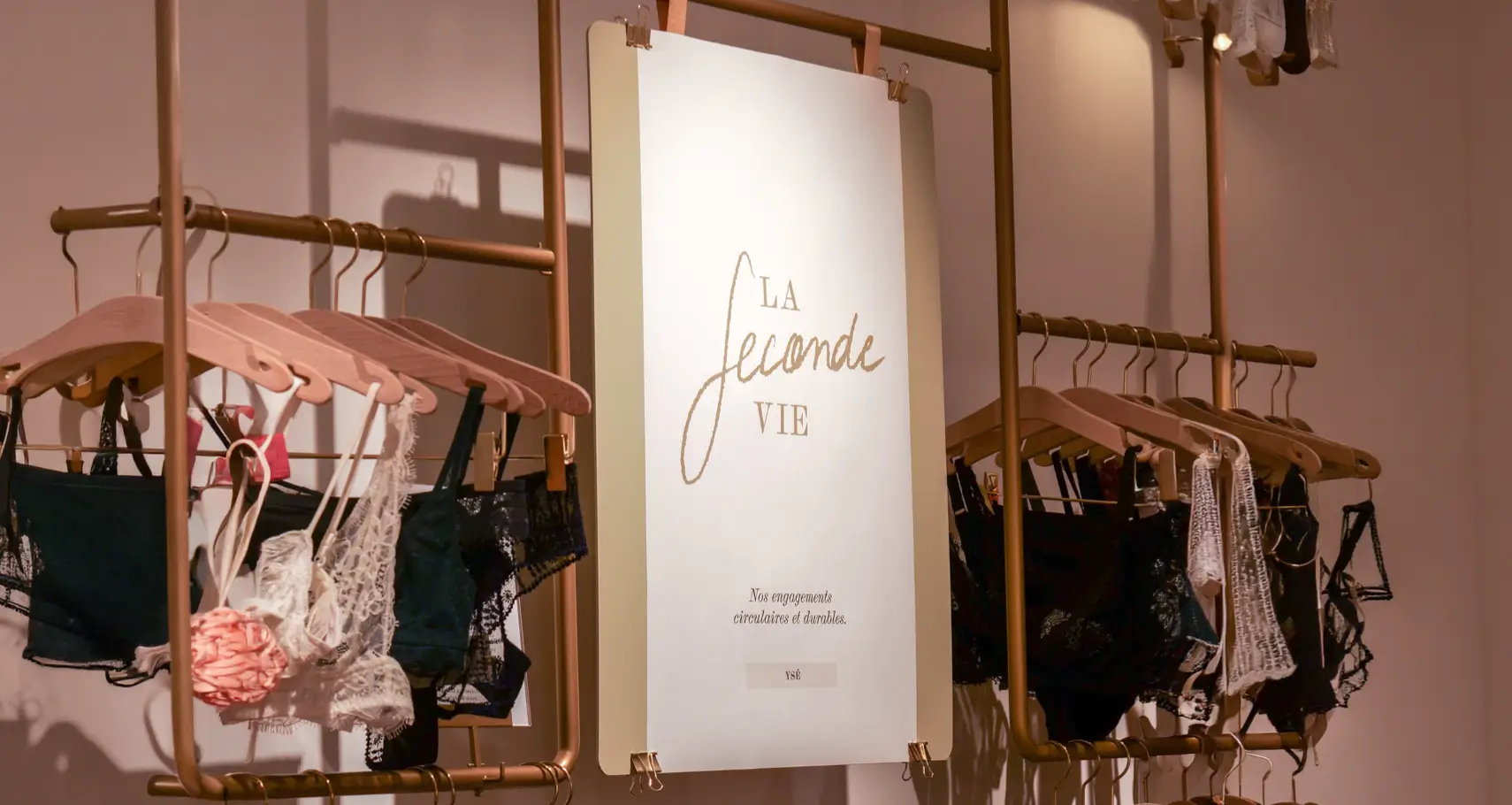
Launched in 2022, Ysé’s “Seconde Vie” programme collects, repairs, and resells pre-owned items. Items returned in-store are meticulously inspected, carefully cleaned, and, where necessary, repaired by a specialised partner before being resold in dedicated in-store areas or temporary pop-ups. In 2025, over 3,500 items were given a second life. The brand also offers a fully repair service to extend product longevity. As part of this circular approach, Ysé has introduced Acte II, a line made from deadstock materials – unused fabrics from previous collections. This initiative avoids the need for new raw materials while making the most of existing resources.
PHASING OUT SINGLE-USE PLASTICS
The Group continues to reduce the environmental impact of its packaging by limiting its use and progressively eliminating single-use plastics. Since 2021, single-use plastics have been banned from all new packaging formats.
Significant progress has already been achieved: shopping bags, e-commerce packaging, and several product packagings are now made from certified recycled kraft paper sourced from sustainably managed forests. The “kraft band” project, launched in 2021, illustrates this approach: it has enabled the elimination of more than 4.7 tonnes of plastic since 2024, and the Group is currently accelerating its rollout to compatible products.
To go even further in reducing e-commerce packaging, Maison 123 offers a reusable packaging solution in partnership with Hipli, allowing parcels to be reused up to 100 times. Single-use plastic reduction also extends to Etam and Undiz multipacks, which are now packaged in certified recycled cardboard.
Overall, these initiatives have enabled the Group to avoid 546 tonnes of single-use plastic each year since 2020.
OUR COMMITMENTS, BASED ON THREE PILLARS: